A’ja Wilson Is No Longer Chasing History. She’s Deciding What It Looks Like.

Defensive Disruptors looks at the players who change games by taking things away, disrupting rhythm, and making every possession harder.
There is a stage of greatness where comparison stops being enough. A’ja Wilson has reached it.
When Great Becomes Normal
Through late August, A’ja Wilson is averaging 26.3 points and 9.8 rebounds per game this season. That sentence should sound absurd. Instead, it barely feels surprising anymore.
That may be the clearest sign of where Wilson’s career has reached. Twenty-six points. Nearly ten rebounds. Elite defense. Another season spent at the center of everything Las Vegas does. For almost any other player, a stretch like that would generate constant reminders of how extraordinary it is. With Wilson, it can start to feel like the baseline. The WNBA currently lists her at exactly 26.3 points and 9.8 rebounds per game.

That is the strange consequence of sustained greatness. Eventually, the numbers stop shocking people because the player producing them has already taught us to expect something close to impossible. Wilson has spent so many seasons dominating the WNBA that there are nights when excellence feels less like an accomplishment and more like an obligation.
There was a time when the question was whether Wilson belonged among the best players in the league. Then it became whether she belonged among the best players of her generation. Those questions have been answered. The more interesting one now is what happens when a player becomes the measuring stick while she is still adding to the résumé.
Because A’ja Wilson is not simply accumulating history anymore.
She is helping decide what WNBA dominance is supposed to look like.
South Carolina and Learning What Excellence Requires
Before Las Vegas expected Wilson to carry championship expectations, South Carolina taught her what it meant to become inseparable from a program’s identity.

Wilson arrived in Columbia as the No. 1 recruit in the country and chose to stay home. The Gamecocks were already rising under Dawn Staley, but Wilson helped push that growth into something permanent. During her four seasons, South Carolina won four consecutive SEC Tournament championships, reached two Final Fours and won the program’s first national championship in 2017.
Those accomplishments matter, but the more important lesson may have been what they required. South Carolina did not teach Wilson how to be talented. She arrived with that. It taught her what happens when an entire program begins expecting excellence from you. Winning once changes a season. Winning repeatedly changes the standard.
By the end of Wilson’s college career, South Carolina was no longer hoping to become one
of the country’s elite programs. It expected to live there. Wilson was learning early what it feels like when your best stops being a surprise and starts becoming something people believe you owe them. Years later, the university would place an 11-foot statue of her outside Colonial Life Arena and retire her No. 22.
A’ja Wilson has spent years leaving places with a different definition of what they should expect from themselves.
Behind much of that development was Dawn Staley. Their relationship became larger than basketball. Wilson has called Staley her second mother, and Staley became someone she could talk to about basketball, teammates and life beyond the court. Wilson has spoken about how meaningful it was to be coached by a Black woman who had already traveled many of the paths she hoped to follow herself.

That matters when looking at the leader Wilson eventually became. Staley gave her an example of what it could look like to demand excellence without requiring a player to surrender the parts of herself that existed outside basketball. Years later, Wilson has become that kind of figure for someone else.
The standard was passed to her.
Now she is passing it forward.
Las Vegas Gave Her a Franchise. She Gave It an Identity.
The Las Vegas Aces selected Wilson first overall in 2018, and she was Rookie of the Year immediately. But the franchise she entered was not yet the dynasty we recognize now. That distinction matters.

Wilson did not arrive in Las Vegas and simply inherit championship infrastructure. She became one of the central pieces around which that infrastructure was built. The Aces grew as she did. They became more disciplined, more physical, more ambitious and more comfortable with expectation. Over time, Wilson’s personality became impossible to separate from the organization’s basketball identity.
Las Vegas plays with confidence because its best player does. It expects to compete deep into the postseason because Wilson has made that expectation reasonable. The Aces have now won three championships — 2022, 2023 and 2025 — and Wilson has been part of all three.

But her influence is not limited to what happens after the ball goes up. Wilson’s leadership is visible in the way she communicates with teammates, celebrates someone else’s moment and accepts accountability herself. There is an important difference between being the best player in a hierarchy and becoming the person who helps establish what everyone in the room believes the work should look like.
Leadership around superstars can sometimes become separation. Wilson’s has often looked more like connection. She can demand because she is willing to be demanded from. She can expect because she has spent years meeting expectations herself.
Wilson is not simply a star wearing an Aces jersey.
At this point, it is difficult to imagine the modern identity of the franchise without her.
The Offensive Evolution
Wilson has always been difficult to guard. What has changed is the number of ways defenses can fail.
Early in her career, much of the challenge centered on her size, strength and ability to establish position around the rim. She could seal smaller defenders, finish through contact, control the glass and punish teams that allowed her to catch too deep. Then the face-up game expanded. The midrange became more reliable. The footwork became more precise. The counters kept multiplying.
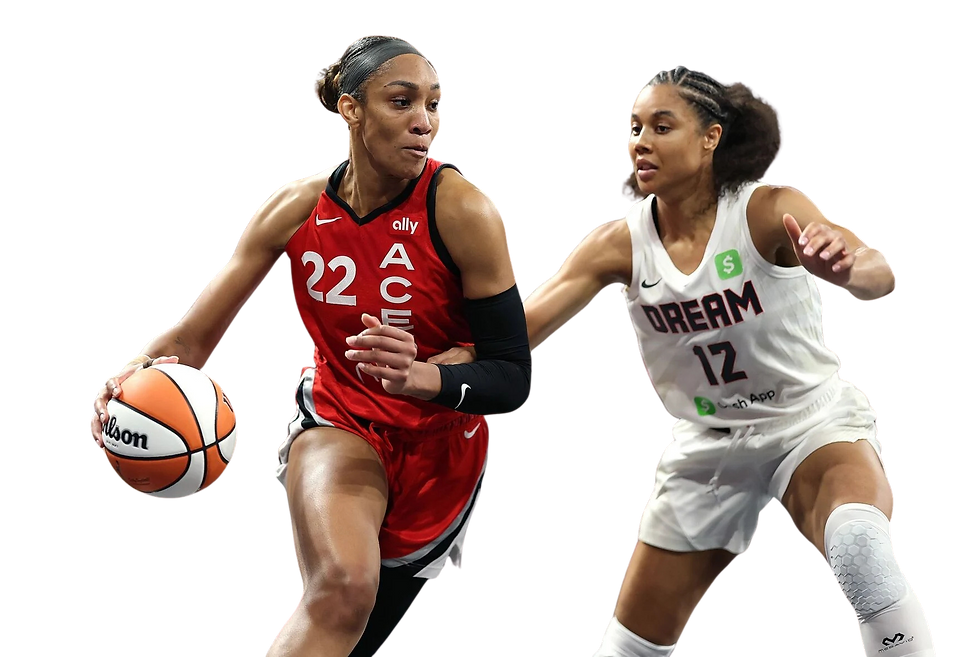
That is the part of Wilson’s offensive evolution that has made her increasingly difficult to scheme. There is no single place a defense can comfortably send her anymore. Play her with size and she can create space with her footwork. Give her room and she can rise into the jumper. Crowd her and the first step becomes available. Switch a smaller defender onto her and she can take her inside. Send help and the defense has compromised something else.
Every time a defense found a place it preferred Wilson to operate, she became better there too.
They eliminate the places where defenses used to find relief.
Her 2025 scoring title came with 23.4 points, 10.2 rebounds, 3.1 assists, 2.3 blocks and 1.6 steals per game. She led the league in scoring for the second consecutive season and also led it in blocks per game.
Those numbers are spectacular, but the more important thing is what they represent. There is no longer one version of A’ja Wilson that a defense can prepare for.
There are too many.
Defensive Disruptor Is More Than a Block Total
This is where Wilson fits this series most clearly.
A lot of superstars dictate what happens when their team has the basketball. A’ja Wilson dictates possessions she never touches.

She protects the rim, but calling her a rim protector is not enough. She can recover after helping, erase drives from the weak side, rebound possessions cleanly, defend farther from the basket and give Las Vegas flexibility when a possession breaks down.
Sometimes her best defensive work never becomes a block. A guard turns the corner and sees Wilson waiting, so the layup becomes a floater. A drive becomes a kick-out. An offensive player hesitates long enough for the original defender to recover. What looked like an advantage disappears before the possession produces anything worth recording.
Those moments do not always give Wilson a statistic.
They still belong partly to her.
Her presence changes what her teammates are allowed to do too. Perimeter defenders can pressure higher because they know Wilson is behind them. Guards can become more aggressive. Rotations can arrive earlier. One mistake on the perimeter does not automatically become two points because the possession still has to survive her.
That is disruption. Not simply taking the ball away, but taking the offense away from where it wanted to go.
Wilson won Defensive Player of the Year in 2022, 2023 and 2025, sharing the most recent award with Minnesota’s Alanna Smith. Three trophies establish the recognition. They still do not completely explain the effect.
Then the possession flips, and the defender everyone spent the previous 20 seconds trying to avoid becomes the offensive matchup the scouting report is built around.
That is what makes her version of dominance exhausting.
There is almost no portion of a basketball game where A’ja Wilson stops mattering.
2025 Was the Whole Argument in One Season
The 2025 season may be the cleanest argument for what separates Wilson from almost everyone else.
She won MVP. She won Defensive Player of the Year. She led the league in scoring. Then the postseason came, Las Vegas won another championship and Wilson added Finals MVP.

One season gave us the league's best player, one of its best defenders, its leading scorer and the best player on the championship stage in the same person.
Wilson became the first player in WNBA history to win MVP, Defensive Player of the Year and Finals MVP in the same season.
At some point, the word complete stops feeling like praise. It becomes description.
There are players who can control an offense, defenders who can transform a scheme, stars capable of carrying the emotional weight of a franchise and players who deliver when a season narrows to its most important possessions.
Wilson has increasingly become all of those things at once.
That is why MVP has started to feel less like a trophy attached to one A’ja Wilson season and more like shorthand for the position she occupies in the league.
When MVP Became the Expectation Instead of the Achievement
Wilson won her first MVP in 2020, another in 2022 and a third in 2024.
Then came 2025.
Her fourth.
No player in WNBA history had ever done that before. Wilson passed Sheryl Swoopes, Lisa Leslie and Lauren Jackson, who each won three.
That should have settled something. Instead, it created another expectation. This is what happens when someone reaches a level no one else has: the achievement stops ending the conversation and begins changing it.

Wilson is no longer measured only against the rest of the league in a given season. She is measured against herself. A good night can feel underwhelming because we have seen the great ones. Twenty-two points might look ordinary because she has scored 35. Ten rebounds might disappear because we remember 20. A season that would establish another player as a superstar can become an invitation to ask whether Wilson has somehow fallen below her own standard.
That is a heavy place to live. There are fewer nights when people allow you to simply be good.
Perhaps that is the clearest sign of what Wilson has become. MVP is no longer something people wonder whether she is capable of winning.
It is something they expect her to be in position to win almost every year.
The Championships Changed the Conversation
Individual greatness always sounds different once championships arrive. Before 2022, Wilson’s résumé was already exceptional, but team success changes the language around superstars. It always has.
Las Vegas won its first championship in 2022, repeated in 2023 and, after New York interrupted the run in 2024, returned in 2025 and swept Phoenix in the Finals. Wilson was named Finals MVP after averaging 28.5 points, 11.8 rebounds and 4.0 assists. Her 114 points were the most ever scored in a single WNBA Finals series, and she became the only player in Finals history to average at least 25 points and 10 rebounds across a series.

At some point, “big-game player” stops being enough. Wilson has built a career where the postseason no longer exists as a separate test of her greatness. It has become another place where the same expectations follow.
The championships changed the conversation because they removed one of the few remaining questions people could ask.
Could her dominance produce titles?
Yes. Three of them.
The 2025 title felt especially significant because it came during a season when Wilson had already demonstrated that she could dominate almost every part of the game. The MVP told us she was the league's best player. The DPOY documented her defensive dominance. The scoring title captured the offensive responsibility. The Finals MVP confirmed that when everything narrowed to the biggest stage, the standard traveled there with her.
The Standard Still Has to Be Carried by a Person
There is an easy way to tell an A’ja Wilson story now: list the MVPs, count the championships, mention the statue, signature shoes, gold medals and records, and let the résumé make the argument.
But résumés do not carry expectations.
People do.
That distinction matters because greatness can make an athlete look almost invulnerable from the outside. When someone produces at Wilson’s level for long enough, we can forget that the person underneath the accomplishments still experiences the weight of everything attached to them.
Wilson has never presented herself as someone whose humanity disappeared once the trophies started arriving. Her foundation, created in 2019, grew partly from her own experience with dyslexia and focuses on supporting children with dyslexia while addressing bullying and helping young people build confidence. In 2024, she received the WNBA's Dawn Staley Community Leadership Award for that work and her broader community impact.
That part of her story deserves space beside the basketball. The same player who has become a standard for dominance understands what it feels like to move through a world that may make a young person question whether something about herself is a limitation.
Being the standard does not mean pressure stops affecting you.
It means learning how to carry it without pretending it weighs nothing.
The Face of the League Is More Than the Most Famous Player
There are different ways to become visible in professional sports. A viral moment can do it. A massive fan base can do it. Timing, personality and cultural relevance can do it too. None of those things are insignificant.
But when I call A’ja Wilson the face of the WNBA, I mean something slightly different.

I mean the basketball standard of this era runs through her.
Want to talk about scoring? Start with A’ja. Defense? Three Defensive Player of the Year awards. Championships? Three. MVPs? Four, more than anyone in league history. International basketball? Two Olympic gold medals, a World Cup MVP and an Olympic MVP.
The WNBA can and should have many faces. Different players bring different audiences into the sport, and that variety is part of what makes this era so compelling. But there is a difference between being visible within an era and defining its competitive standard.
A’ja Wilson has earned the latter.
She is not the face of the WNBA because someone simply decided to market her that way.
The visibility did not create the greatness. The greatness eventually became too significant to ignore.
The Brand Finally Caught Up to the Basketball
For years, there was a noticeable gap between the magnitude of Wilson’s basketball résumé and the individual marketing infrastructure surrounding her.
That gap has narrowed.

Her first Nike signature shoe, the A’One, launched in 2025. In 2026, Nike introduced the A’Two alongside an expanded signature apparel collection. The A’Two and second apparel collection became globally available May 2.
There is something fitting about the product evolving alongside the player. But the significance is bigger than Wilson having her name attached to a sneaker.
A young player can walk into a gym wearing A’ja Wilson’s name on her feet. She can see Wilson’s statue at South Carolina. She can watch her collect MVPs and championships and dominate internationally. She can see a Black woman positioned at the center of basketball performance and culture without being asked to separate dominance from femininity, humor, style or joy.
That visibility matters.
Wilson does not have to become less expressive to look serious. She does not have to become harder to look powerful. She gets to be all of it.
A signature shoe is still a product, but it can also become basketball inheritance. The players growing up watching A’ja now have something carrying her name that they can wear while becoming whatever comes next.
That is what happens when individual achievement begins creating infrastructure for someone else.
Even Her Absence Changes the Equation
Wilson will not play for Team USA at the 2026 FIBA Women’s Basketball World Cup after withdrawing for health reasons. Sonia Citron and Kiki Iriafen were added to the roster after Wilson and Kelsey Plum were ruled out.
Her absence does not create another question about what she can do internationally. It emphasizes how much she has already done. Wilson has two Olympic gold medals and was named MVP of the 2022 FIBA Women’s Basketball World Cup and the 2024 Paris Olympics.
Team USA is entering this tournament without the player who was its MVP at each of the previous two major international competitions.
That is not a normal absence.

There is no one-for-one replacement for a player who can anchor a defense, command an offense, control the glass and enter virtually every major game accustomed to being the person everyone expects to deliver.
Her absence doesn't diminish the roster replacing her, nor does it create something else for Wilson to prove. Sometimes value is clearest through presence. Sometimes it becomes just as clear when that presence is removed.
You notice when the standard is not there.
The Cost of Becoming the Standard
There is another side to being the measuring stick. When Las Vegas wins, A’ja is supposed to dominate. When Las Vegas loses, people ask what A’ja could have done differently. When she scores 35, it confirms what everyone already believes. When she scores 20, the number can somehow feel small.
That is the strange economy of generational greatness. Eventually, extraordinary performances stop earning surprise and ordinary human performances start requiring explanation.

Wilson has spent years living inside that imbalance. That is why her consistency deserves more attention than it sometimes receives. Greatness is not only reaching a level few others can reach. It is returning to that level often enough that people forget how difficult the climb was.
Wilson has done that across different teammates, different opponents, different postseason runs and different versions of her own game. She has adapted without losing the things that made her dominant in the first place.
And maybe that is the hardest part of becoming the standard.
You cannot simply reach it once. Everyone expects you to keep meeting yourself there.
The Standard Creates Something Behind It
There is another way to understand Wilson’s place in this era.
Look behind her.
The statue is there. The foundation is there. The signature line is there. So are young players growing up in a version of basketball where A’ja Wilson is not a hypothetical example of what a women’s basketball superstar could become.
She is an existing one.

Dawn Staley once gave Wilson a model for what it could look like to be a Black woman at the center of basketball excellence and leadership. Wilson has talked about how much seeing that mattered to her.
Now another generation gets to see Wilson.
That is how standards become legacy before a career is even finished. Not simply because people remember what you accomplished, but because your existence makes the next possibility easier for somebody else to imagine.
She Is the Measuring Stick Now
A’ja Wilson does not need another season to prove she belongs among the greats. She does not need another MVP to validate the first four, another championship to prove her dominance can produce one or another gold medal to establish what she can do on the international stage.
Those questions have already been answered.
Everything she adds now feels less like validation and more like expansion. Another scoring title moves the standard. Another elite defensive season moves it again. Another championship changes the historical distance between Wilson and much of the field around her. Another MVP would force us to reconsider what an MVP résumé can even look like.

We are not waiting for the résumé to become historic.
It already is.
Four-time MVP. Three-time WNBA champion. Three-time Defensive Player of the Year. Two-time Finals MVP. Two-time Olympic gold medalist. NCAA champion. World Cup MVP. Olympic MVP.
And she is still playing some of the best basketball of her career. The league's current player page lists her at 26.3 points and 9.8 rebounds per game this season — numbers that would define another player's peak and somehow still feel like part of Wilson's ongoing evolution.
There will eventually be another dominant forward, another No. 1 pick expected to transform a franchise and another young star with size, footwork, touch and defensive instincts that make scouts begin searching for the right comparison.
For years, A’ja Wilson was the player being compared with the greats who came before her.
We are reaching the point where the next generation may be compared to her instead.
That is what being the face of an era should ultimately mean. Not being the loudest name. Not having the largest following. Not winning some endless popularity contest.
It is being the player whose greatness helps explain the basketball being played around her.

A’ja Wilson has reached that point.
The accolades explain part of it. The championships explain another. But the strongest argument is still visible in the game itself: the footwork, touch, patience, strength, defensive awareness, rim protection, rebounding, counters, adaptability and the almost unfair reality that after years of professional basketball, she is still finding ways to become more complete.
There is a stage of greatness where comparison stops being enough.
A’ja Wilson is there.
She is no longer trying to reach the standard.
She is deciding what the standard looks like.


Comments