Dear Satou, Your Story Is So Much Bigger Than This Moment

An open letter to Satou Sabally about the basketball that brought her here, the strength it has taken to keep coming back, and why there is no timeline more important than getting healthy.
Dear Satou,
I thought about beginning this letter with the news: another stretch of basketball interrupted before you were ready for it to be, another moment taken away by something you never asked for, another reminder that the thing you have spent so much of your life doing sometimes has to wait.
But the more I thought about it, the more I realized I don't want to start there.

Because your story deserves to be bigger than an injury.
Before talking about what you are going through now, I want to spend some time with everything it took for you to get here. The basketball. The places it has carried you. The player you became. The things you have already helped make possible.
Because there was a reason people started calling you The Unicorn long before this latest chapter.
And that part of your story matters too.
Long Before the WNBA Knew Your Name
Your basketball story did not begin in Dallas, Phoenix or New York.
You were born in New York but raised in Germany, growing up in Berlin before your family eventually moved to Freiburg. Basketball found you there, and over time, that tall kid from Germany started becoming something the game did not have an easy category for.

At 6-foot-4, you were never confined to playing like a traditional forward. You could handle the ball, shoot, create, rebound, defend and run the floor. You could punish a smaller matchup inside and pull a bigger defender somewhere she did not want to go. A rebound could turn into your own transition opportunity without needing a guard to come take the ball from you.
Eventually, there was a nickname for players built that way.
The Unicorn.
It fit because the unusual part was never simply your height. It was how many different things you could do with it.
Before Oregon, you had already gained experience playing in Germany with Freiburg. Then came the decision that would take you across the Atlantic and into one of the most recognizable programs in women's college basketball.
Oregon.
Oregon Was Where More People Started Paying Attention
There was already plenty of talent waiting when you arrived in Eugene.
Sabrina Ionescu was there. Ruthy Hebard was there. Oregon was building something.
You became part of the group that pushed it somewhere the program had never been before.

Across three seasons, Oregon won three Pac-12 regular-season championships. You became a two-time All-Pac-12 selection, earned All-America recognition and eventually won the 2020 Cheryl Miller Award as the nation's top small forward.
But the accomplishment I keep coming back to happened before any of that ended.
In 2019, Oregon reached its first Final Four.
For the first time in program history, the Ducks were playing on the final weekend of the women's college basketball season. You were part of the group that expanded what Oregon basketball believed was possible.
Maybe that is one of the first themes that appears when looking at your career from a distance.
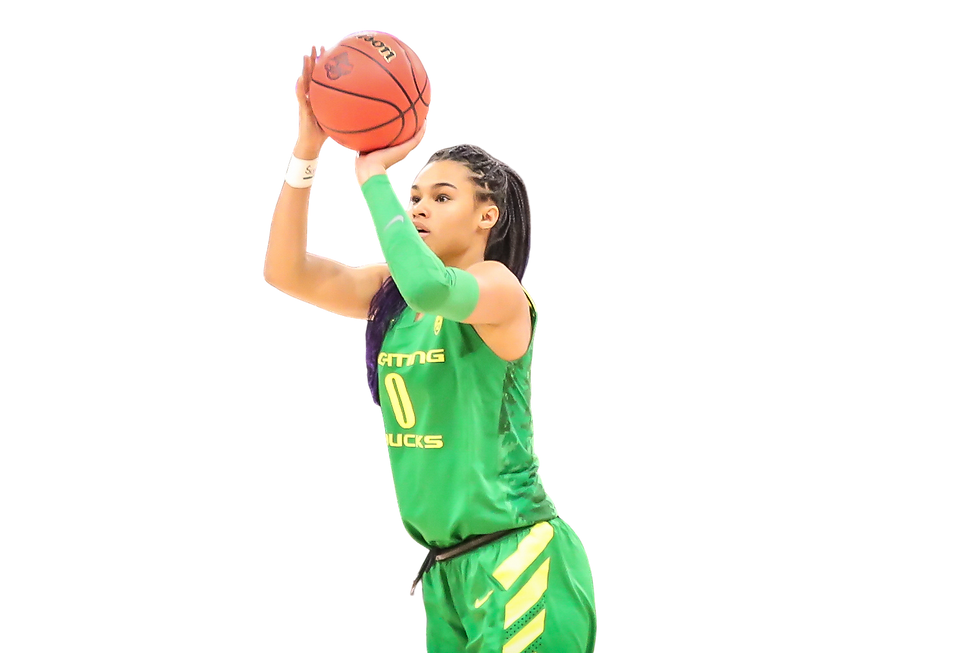
You have spent a lot of it expanding possibilities—for your teams, for German basketball, and for what a player with your size is allowed to look like.
The Unicorn wasn't just a nickname.
It was a description of the problem you created.
Then Dallas Called Your Name
The Dallas Wings selected you second overall in the 2020 WNBA Draft, making you one of the first names called and one of the most highly regarded players entering the league.
Almost immediately, we could see why.
You averaged 13.9 points and 7.8 rebounds as a rookie and earned a spot on the WNBA All-Rookie Team. A year later, you became an All-Star for the first time.
But telling your career honestly also means acknowledging what has interrupted far too much of it.

Injuries changed seasons and timelines, repeatedly asking you to stop when nearly everything about being a professional athlete teaches you to keep moving.
There were years when we only got pieces of Satou Sabally. Seventeen games in 2021. Eleven in 2022. Fifteen in 2024 after a shoulder injury kept you out for the first 25 games.
That had to become exhausting in ways people outside of professional sports probably cannot fully understand.
Athletes want to be evaluated by what they can do.
Injuries have a way of making everyone spend too much time discussing what they cannot.
Then came 2023.
2023 Wasn't Potential Anymore
There had always been flashes.
In 2023, the flashes became a season.
You averaged 18.6 points, 8.1 rebounds, 4.4 assists and 1.8 steals. You became an All-Star starter, won WNBA Most Improved Player and earned All-WNBA First Team honors. The numbers put you in rare company too, joining Candace Parker among players to average at least 18 points, eight rebounds and four assists across a season.
But even those awards don't completely explain what that season felt like.
For years, people had talked about what Satou Sabally could become if everything came together.
Then everything came together.

There was the triple-double against Washington. There was the 40-point game against Indiana, when you became the first player in WNBA history to score at least 40 points in fewer than 30 minutes. There was Dallas winning 22 games and advancing to the WNBA semifinals.
Suddenly the conversation did not have to be about potential anymore.
You had already become the player people kept waiting to see.
That is why I've always hated how easily injuries become part of the first sentence when people talk about certain athletes.
Because yes, injuries are part of your story.
But so is the All-Star. The All-WNBA forward. The 40-point scorer. The player capable of grabbing a rebound and beginning the break herself. The 6-foot-4 forward who could make a possession look completely different depending on what the defense gave her.
The Unicorn.
That is part of your story too.
Even a Shortened Season Still Looked Like Satou
Then 2024 asked for patience again.
A shoulder injury cost you the first 25 games of the WNBA season, leaving only 15 for you to play with Dallas. That could have turned the year into another incomplete chapter.
Instead, you came back and reminded everyone how much your game had continued to grow.

You averaged 17.9 points, 6.4 rebounds and a career-high five assists while shooting 45.2 percent from three. You and Caitlin Clark were the only players in the league that season to average at least 15 points, five rebounds and five assists.
Fifteen games were not enough to give you the season you wanted.
They were enough to show that 2023 had not been some temporary peak.
The player was still there.
Then came Paris.
Germany Got Its Moment
What you have meant to Germany feels especially important now.
In 2024, Germany's women's basketball team made its Olympic debut.
And you helped show that Germany belonged there.

You averaged 18.8 points in Paris, the second-highest scoring average in the tournament, including 33 against Japan. Germany reached the quarterfinals in its first Olympic appearance, and you were named to FIBA's All-Second Team.
Think about the scale of that for a moment.
A kid who grew up playing basketball in Germany eventually stood on the Olympic stage helping lead the country that raised her somewhere its women's national team had never been before.
There are girls in Germany who now know exactly what that stage looks like because they watched you stand on it.
That is bigger than a stat line.
And I imagine that is part of what makes this moment so difficult.
Because the 2026 World Cup isn't happening just anywhere.
It's happening in Berlin.
Home.
You had worked toward the opportunity to play a World Cup there for years. Instead, the lingering effects of your head injury led to a decision no competitor wants to make: listen to your body, put your health first and focus on recovering fully.
I can't know what it felt like to make that decision.
But I hope you know there is strength in it too.
Phoenix Brought You Closer Than Ever
After five seasons in Dallas, your WNBA career changed directions in 2025.
Phoenix brought a new city, new teammates and another opportunity to show what your basketball looked like over a fuller season.

You played a career-high 39 games, averaged 16.3 points and 5.9 rebounds and became an All-Star for the third time. Then your game rose with the postseason. Across Phoenix's playoff run, you averaged 19 points and seven rebounds.
Most importantly, Phoenix kept winning.
Until there was only one series left.
The WNBA Finals.
After all of the interrupted seasons and all of the questions about what your career might look like if you could simply stay on the floor, you were not watching someone else's championship opportunity.
You were in the middle of one.
And you were playing some of your best basketball of the postseason when Game 3 changed everything.
You had 24 points, five rebounds and three assists as Phoenix fought to extend the series. Then you went down after making contact with another player, and suddenly the basketball became secondary.
You were helped from the floor, diagnosed with a concussion and unable to return for Game 4.
The symptoms did not disappear when the season ended.

They followed you into the offseason. They kept you out of Unrivaled. And they required a kind of patience basketball players are rarely trained for.
This was not something you could solve by getting extra shots up.
You could not decide you were tired of waiting and simply push through.
Recovery had to happen on its own timeline.
And eventually, you worked your way back.
Again.
New York Was Supposed to Be the Next Beginning
The Liberty signed you before the 2026 season, and on paper, the possibilities were obvious.
Satou Sabally alongside Breanna Stewart and Jonquel Jones gave New York three frontcourt stars with size, skill and All-WNBA résumés. For you, it offered another opportunity to join a championship environment, settle into a role alongside other stars and simply play basketball again after an offseason when getting healthy enough to do that had already required so much.
Even reaching your Liberty debut required patience.
Then, little by little, you started playing again.

There were flashes of what the fit could eventually become. The movement, the shooting, the size, the ability to attack mismatches without needing the offense built entirely around you.
The Unicorn was beginning to find space in another ecosystem.
Then June 23 happened.
Another hit to the head.
Another concussion.
Another interruption.
You haven't played since. Even after clearing concussion protocol, related symptoms remained, and eventually you stepped away from the team to focus on your health.
There is no useful basketball timetable to attach to that right now.
The Liberty can wait.
The World Cup has had to wait.
What matters is giving your body the time it is asking for.
I Hope You Give Yourself All of It
Satou, I obviously don't know you personally.
I don't know what these last few months have felt like when the cameras are gone. I don't know how frustrating it is to watch practices or games you want to be part of. I don't know how many good days have been followed by difficult ones or how often you've wondered when normal will finally feel normal again.
And I don't want to pretend I do.

What I do know is that basketball has been part of your life for a very long time.
Right now, I hope you know you are allowed to be Satou before you are a basketball player.
There is no playoff game important enough to rush this. No World Cup important enough. No comeback date important enough. No expectation from a team, fan or league that should matter more than you feeling like yourself again.
So I hope you take the time.
Not the amount of time basketball wants. Not the amount of time a season requires.
Yours.
Your Career Deserves Its Flowers Right Now
Sometimes sports waits too long to celebrate people.
We wait until retirement. We wait until the jersey goes into the rafters. We wait until someone isn't playing anymore and suddenly begin talking about everything we should have appreciated while she was still here.
I don't want to do that with you.
You're already a three-time WNBA All-Star, an All-WNBA First Team forward and a Most Improved Player. You became the No. 2 pick in the draft. You won a EuroLeague championship. You helped Oregon reach its first Final Four. You helped Germany reach its first Olympics and then its first Olympic quarterfinal.
And through all of it, you became one of the most distinctive forwards in basketball.

There is a reason The Unicorn stuck.
Players who are 6-foot-4 are not supposed to move exactly the way you do, see the floor the way you do, initiate offense the way you do and force defenses to decide whether they should treat you like a wing or a big.
That versatility has survived every interruption.
At 28, you have already built a basketball life worth celebrating.
None of that disappears because the game has been interrupted again. None of it becomes smaller because you don't know exactly when the next game will come. And none of it requires a comeback to become meaningful.
You already did it.
Those flowers belong to you now.
Your Story Isn't Waiting on a Return Date
I hope there is more basketball.
I hope there are more All-Star Games, playoff runs and German national team moments. I hope someday we get to watch you grab a rebound, push the ball yourself and remind everyone again how unusual it is for someone your size to make the game look that fluid.
I hope we get to watch The Unicorn be The Unicorn again.

But I'm not going to tell you that we will.
Recovery from a head injury deserves more respect than certainty from somebody who isn't living inside your body. Hope doesn't require a promise.
I can hope for all of those things while still believing the most important thing is that Satou Sabally gets healthy.
Not basketball healthy.
Not whatever version of healthy allows everyone else to start asking when you'll play again.
Healthy.
Everything else can wait.
Basketball has asked you to come back before, and you have. Again and again.
Maybe this time doesn't need to be another demonstration of resilience.
We already know you are resilient.
You've shown us.

This time can simply be about healing.
There are German fans who know what you helped make possible. Oregon fans who remember the first Final Four. Dallas fans who watched you grow into an All-WNBA player. Phoenix fans who watched you help take a team all the way to the Finals. New York fans who were excited to see what this next chapter could become.
And there are plenty of us who don't need you to rush back to keep rooting for you.
So take care of yourself, Satou.
Take the time your body is asking for. Let the people who love you carry some of this with you, and know that I'm sending you love and prayers for healing, peace and a complete recovery, just like so many others who are rooting for you.
Your story is not on hold until you step onto a basketball court again.
It is already so much bigger than this moment.
Basketball will be there if and when you're ready for it again.
And so will we.
We're rooting for you, Unicorn.
With love,
Asia
Courtside With Asia


Comments