Underrated Spotlight: Kayla McBride Turned Precision Into Pressure

Dynamic Shooters explores the players whose shooting creates pressure, changes defenses, and reshapes the game around them.
The shot has always been beautiful. What makes Kayla McBride special is everything she learned to build around it.
There are nights when a shooter catches fire, and then there are nights when the defense starts running out of answers.

On August 9, Kayla McBride reached the second kind. Ten three-pointers. Forty-three points. A WNBA single-game record from beyond the arc.
By the time the final shots were falling against Dallas, the remarkable part was no longer that McBride was making threes. Everyone in the building knew exactly what she wanted to do, and Dallas still could not stop her from doing it.
That is the part of great shooting that can get lost inside percentages and highlight reels. The mechanics matter, and so does the range, but the best shooters create pressure before the ball ever reaches their hands. A defender has to chase a little harder around a screen. Help has to hesitate for another half-second before committing somewhere else. A closeout has to begin earlier because giving McBride even a little space can be enough.
She has spent more than a decade building that kind of gravity.
The 10 threes made history, but the work that made them possible started long before that night.
Before the Shot Became the Story
Basketball arrived early for McBride.
Growing up in Erie, Pennsylvania, she was the oldest of four children in a family where the game was already familiar. Her father, LaMont, worked as a high school basketball official and introduced her to the sport when she was four. Her siblings eventually played college basketball too.

By high school, McBride had become one of Pennsylvania's best players. At Villa Maria Academy, she helped win consecutive state championships and finished her career as the school's leader in points, rebounds, and steals. Her senior season brought Gatorade Pennsylvania Player of the Year honors and a McDonald's All-American selection.
The scoring was already there, and so were the expectations. Notre Dame simply gave both a larger stage.
McBride arrived in South Bend during one of the most successful stretches in program history. Under Muffet McGraw, the Fighting Irish became a fixture at the Final Four, and McBride helped them reach four consecutive national semifinals and three championship games.
Her college career was not perfectly smooth. Academic issues interrupted her freshman season and forced her away from the floor, an early setback in a career that would repeatedly ask her to find her way back from moments she did not expect.
She did.

By the end of her Notre Dame career, McBride had scored 1,876 points while shooting 47.5 percent from the field and 88.2 percent from the free-throw line. She became the ACC Player of the Year, earned First-Team All-America recognition, and left as one of the most accomplished players in program history.
More importantly, she left with a game that already had layers. McBride could score from the midrange, attack off the bounce, move without the ball, and punish defenders who gave her too much room. The three-pointer would eventually become one of the defining pieces of her professional career, but she was never built as a player who could only stand in a corner and wait.
She was a scorer first, and the shooting became the weapon that changed everything around her.
Learning What Professional Scoring Requires
San Antonio selected McBride third overall in the 2014 WNBA Draft, and responsibility arrived almost immediately. She led the Stars in scoring as a rookie, averaging 13 points per game, earning unanimous All-Rookie honors, and setting the franchise's rookie scoring record.

The transition was quick, but professional basketball eventually introduced a different kind of challenge.
In 2016, McBride was averaging what was then a career-best 17.1 points per game when a significant right foot injury ended her season. For a player whose game depended on footwork, balance, repetition, and rhythm, rehabilitation meant rebuilding more than conditioning.
Shooting mechanics begin at the ground. So does the ability to stop quickly, square through movement, plant into a pull-up, or run a defender through multiple screens before rising into a jumper. An injury to the foot does not simply interrupt a season for a player like McBride. It interrupts the foundation underneath nearly everything she does offensively.
She returned and kept expanding.

When the franchise relocated to Las Vegas, McBride entered another phase of her career. Playing alongside A'ja Wilson and an increasingly talented Aces roster, she averaged a career-best 18.2 points in 2018 and made another All-Star team. By 2020, the Aces had reached the WNBA Finals.
McBride had already proven she could score at this level. What came next was learning how much pressure her shooting could create even when she was not the player controlling the possession.
Minnesota Changed the Volume
When McBride signed with Minnesota in 2021, she did not arrive needing to prove she could make shots. The question became how many different ways those shots could bend a defense.

Over the next several seasons, her three-point volume climbed. She became increasingly comfortable sprinting into actions, relocating after giving up the ball, using screens without needing multiple dribbles to find her rhythm, and punishing even the smallest lapse in coverage.
That matters because movement shooting asks something different from a player than ordinary spot-up shooting. The feet have to organize while the body is still moving. The shoulders have to square quickly. The ball has to travel directly into the shooting pocket. There is rarely enough time to catch, reset, and think.
McBride's release became especially valuable because so little of that process appeared separate. Catch, set, release. The entire sequence could happen before a defender completed the closeout.
By 2025, she had become one of the league's highest-volume perimeter threats, making 103 threes while shooting 39.5 percent from deep. Minnesota finished the regular season 34–10.
And somehow, another level was still waiting.
Year Thirteen Somehow Added Another Layer
There is something unusual about a player entering her thirteenth WNBA season and producing some of the best basketball of her career.
McBride has done exactly that.
In 2026, she is averaging more than 18 points per game while shooting around 40 percent from three on high volume. She's also producing one of the strongest defensive seasons of her career, adding another layer to a year already defined by elite shooting.
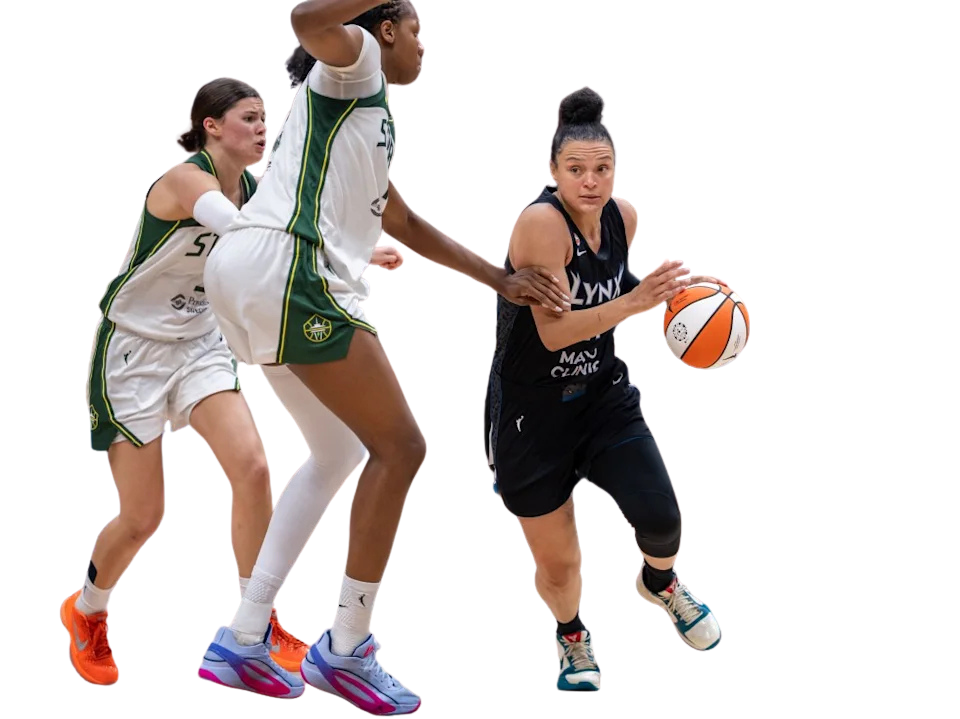
The numbers matter because efficiency and volume are difficult to maintain together. Making threes at a high percentage is one thing. Making them while defenses are actively designing possessions around preventing you from getting them is another.
McBride's off-ball movement creates consequences even when she never receives the pass. Defenders have to trail her through screens. Switching can produce mismatches somewhere else. Help defenders have to decide whether leaving her for even a moment is worth the risk.
That is shooting gravity, and its value is not limited to the points generated when the shot goes in. Sometimes the value is the space created simply because everyone believes it might.
Ten
Then came August 9.
McBride made 10 three-pointers against Dallas and finished with a career-high 43 points.
The number now sits alone in the WNBA record book.

The performance becomes even more impressive when understood as the culmination of years of refinement rather than one extraordinary hot night. The release had been repeated thousands of times. The footwork had been sharpened through seasons of movement. The range had expanded, the volume had increased, and her understanding of how to manipulate defenders with the threat of the shot had grown.
When Dallas gave her even the smallest windows, McBride kept taking them.
Ten times, they went in.
The performance also arrived after McBride had been left off the 2026 WNBA All-Star roster despite putting together one of the strongest seasons of her career, an omission Cheryl Reeve publicly criticized.
McBride did not need a record-breaking game to validate her season, but there was something fitting about the timing. Recognition had missed her, and the basketball made it impossible to look away.
A Shooter Is More Than Her Jumper
Calling McBride one of the league's best shooters is accurate.
It is also incomplete.
The threat of the three creates opportunities for everything else she does. A defender who closes too aggressively becomes vulnerable to the drive. A player trying to prevent the pull-up may give away an angle toward the paint. Once McBride forces help, the possession changes again.

That is what separates a dynamic scorer from a specialist. The jumper creates the first problem. McBride knows what to do with the second one.
She can attack closeouts, draw fouls, get into the midrange, and make decisions after the defense has already shifted toward stopping the shot. The same thing happens without the ball. Her movement forces defenders to communicate through screens and makes every defensive mistake more expensive.
McBride does not need to dominate possession to influence it. Sometimes all she needs to do is move.
The Career Most WNBA Fans Only See Half Of
McBride's résumé becomes even more impressive when the calendar extends beyond the WNBA season.
Her international career has been extraordinary. She has won three EuroLeague Women championships, first with UMMC Ekaterinburg in 2019 before helping Fenerbahçe capture back-to-back titles in 2023 and 2024. In 2024, she was named EuroLeague Women Final Four MVP after averaging 21 points, 6.5 rebounds, and six assists across the Final Four. She has also won domestic championships in Russia and Turkey and surpassed 2,000 career EuroLeague points.

Those seasons matter because overseas success often disappears from the way WNBA careers are discussed in the United States. For McBride, those years represent more than additional trophies. They represent seasons spent adapting to different systems, coaches, teammates, styles, and expectations while continuing to refine the same skills that make her dangerous in Minnesota.
The WNBA has seen one part of her career. Europe has seen another. Together, they explain why very little about her game feels accidental.
The Work Nobody Sees
McBride's career has also included moments when basketball became secondary to simply getting through the day.
During the 2020 bubble season, she spoke openly about her mental health and the anxiety she experienced during the isolation of the COVID-19 pandemic. That honesty mattered because professional athletes are often praised for toughness in ways that can leave little room for acknowledging when the challenge extends beyond basketball.
Her career has required that kind of adjustment more than once. There were the academic issues at Notre Dame, the right foot injury that ended her 2016 season, the emotional strain of competing during the pandemic, and more recently, additional physical setbacks. In January 2026, McBride suffered a right thigh injury while training with Fenerbahçe, another interruption for a player whose game relies so heavily on movement and repetition.
And still, this has become one of the strongest seasons of her career.
That does not mean adversity automatically produces success. It means McBride has spent years learning how to return, and there is an important difference between the two.
The Shot Is Still Getting Better
At some point, longevity can become its own kind of invisibility.
A player has been good for so long that consistency stops feeling remarkable. The All-Star selections accumulate. The threes keep falling. The postseason appearances blend together. Eventually, excellence becomes expected enough that people stop asking how difficult it is to maintain.
Kayla McBride is in her thirteenth WNBA season, and she is producing one of the strongest offensive seasons of her career.
That should still feel remarkable.
The 10-three-pointer game made the league stop and look again, but the record is not the whole story. Neither is the All-Star omission. Neither are the selections that came before it, the EuroLeague championships, the injuries, or the thousands of shots that built the mechanics everyone recognizes now.
The story is that McBride kept adding something: more range, more movement, more volume, more patience, and a deeper understanding of exactly how much pressure one shooter can put on an entire defense.
The form has always been beautiful, and the release has always been quick. But thirteen seasons into her WNBA career, Kayla McBride is showing that the most dangerous thing about a great shooter may be how much better she can still become.


Comments